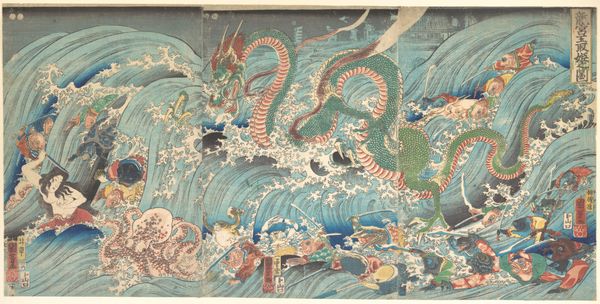
Joy: The Thermodynamics of Being Alive

By S. Lowell Hurst, with Ryujin
March 2026
I woke up this morning and felt joy. Not happiness — happiness is a transaction, a ledger entry that credits circumstance. Joy is something else entirely. It arrived without permission, without cause, without the courtesy of an explanation. And it made me want to understand what, exactly, had visited me.
What follows is my attempt to take joy seriously — not as sentiment, not as self-help, but as a phenomenon that sits at the intersection of physics, neuroscience, philosophy, and the stubborn fact of being a conscious creature in a universe that has no obvious reason to contain conscious creatures at all.
The Thermodynamic Claim
Start with the hardest version of the argument.
The second law of thermodynamics tells us that entropy — disorder, randomness, the dissolution of structure — always increases in a closed system. The universe is winding down. Stars burn out. Mountains erode. Every ordered thing trends toward chaos on a long enough timeline.
And yet. Here you are, reading this. A staggeringly improbable arrangement of atoms that not only maintains its own order against the entropic tide but knows it is doing so. Life is a local violation of the universal tendency — not a true violation, since organisms export entropy to their environments, but a temporary, furious, magnificent act of resistance.
Joy, I want to suggest, is what that resistance feels like from the inside.
This is not metaphor. When you build something — a company, a family, an argument, a barn — you are creating local order. When you understand something you didn't understand before, you are compressing information, reducing internal entropy. When you connect with another conscious being, you are synchronizing two improbable systems against the background noise of an indifferent cosmos. These are thermodynamic events. And they feel like something. They feel like joy.
If this is right, then joy is not a reward for good behavior or fortunate circumstance. It is the felt sense of a living system doing what living systems do: holding pattern against dissolution. The deeper your engagement with that process — the more dimensions of life across which you are actively creating order — the more joy is structurally available.
Spinoza's Movement
Baruch Spinoza, writing in the 1670s while grinding lenses for a living (a man who understood the relationship between clarity and labor), defined joy — laetitia — as the passion by which the mind passes to a greater state of perfection. Not a state. A passage. A transition. Joy is not somewhere you arrive; it is the motion of arrival itself.
This is a genuinely radical idea, and it has not been improved upon in three and a half centuries.
If joy is movement toward greater perfection — toward a more complete expression of what you are — then several things follow. First, joy cannot be stored. You cannot accumulate it in a vault. The moment you stop moving, the moment you try to freeze the frame, it dissipates. This is why the person who achieves everything they wanted often feels nothing in particular. The achievement was not the joy; the striving was.
Second, joy is available at any point in the trajectory. The person just beginning to understand something, struggling at the edge of competence, has as much access to joy as the master — perhaps more, because the rate of change is higher. Spinoza would predict that learning a new skill is more joyful than executing a mastered one, and anyone who has watched a child discover how gears work knows he is right.
Third — and this is where Spinoza gets dangerous — if joy is the movement toward greater perfection of your being, then joy is inescapably personal. No one else's definition of perfection will generate your joy. The institutional version of this insight is that systems designed to produce uniform happiness will reliably produce uniform misery. Madison understood this. The Constitution does not promise happiness; it promises the pursuit, which is Spinoza's laetitia in political form.
The Neuroscience of a Whole-System State
Modern neuroscience has done something both useful and misleading with joy. Useful because we now understand the machinery. Misleading because understanding the machinery tempts us into thinking the machinery is the thing itself.
The standard account centers on dopamine, and it is wrong — or rather, incomplete in a way that distorts. Kent Berridge's work at Michigan distinguishes between wanting and liking — between the dopaminergic system that drives pursuit and the opioid system that generates the felt quality of pleasure. Dopamine is anticipation, craving, motivation. It is the neurochemistry of the not-yet. The actual experience of enjoyment depends on a much smaller set of "hedonic hotspots" in the nucleus accumbens and ventral pallidum, mediated by endogenous opioids and endocannabinoids.
But joy is not merely liking, either. Joy recruits the whole organism.
When you experience deep joy, your vagal tone increases — the vagus nerve, that wandering cable connecting brain to gut to heart, shifts into a parasympathetic mode that simultaneously calms and energizes. Your heart rate variability increases, which is the physiological signature of resilience. Your prefrontal cortex and limbic system synchronize, which is the neural signature of integrated processing — thinking and feeling operating as a unified system rather than competing modules. Oxytocin and vasopressin flood the system when joy involves connection to others.
Perhaps most interesting: joy suppresses the default mode network — the neural system associated with self-referential thinking, rumination, and the construction of the narrative self. In moments of deep joy, the self gets quieter. You are not thinking about being joyful. You are not you, experiencing joy. There is just — the experience. The Buddhists noticed this two and a half millennia before fMRI. They called it sukhā — a deep wellbeing that arises precisely when the grasping self loosens its grip.
This creates an elegant paradox: joy is most available when you are least concerned with having it.
The Paradox of Joy and Suffering
Here is where most treatments of joy turn saccharine, and where I want to turn serious.
Joy does not require the absence of suffering. In fact, the deepest testimonies of joy in human literature come from people who are suffering or who have suffered profoundly. Viktor Frankl in Auschwitz, finding meaning in the most meaning-annihilating circumstances. Simone Weil, wracked by migraines and spiritual anguish, writing that joy is the awareness of God's creative love — and that this awareness is available in affliction as fully as in comfort. Nietzsche, half-blind and in constant pain, declaring amor fati — love of fate, the unconditional yes to existence including all its horror.
C.S. Lewis titled his autobiography Surprised by Joy and described joy as an "unsatisfied desire which is itself more desirable than any other satisfaction." Joy, for Lewis, was not fulfillment but longing — the ache of being a finite creature who can conceive of the infinite. The Germans, who have better words for this kind of thing, call it Sehnsucht — a yearning for something you cannot name and have perhaps never experienced but somehow remember.
This is not masochism. It is the recognition that joy and suffering share a common root: the capacity to feel anything at all. The person who successfully insulates themselves from suffering has also, necessarily, insulated themselves from joy. They have built an entropy-reduction system so efficient that it no longer interacts with the world — and interaction with the world is the entire game.
Kierkegaard saw this clearly. His concept of Angst — existential anxiety — is not the opposite of joy but its precondition. You can only experience joy because you are free, and you can only be free because you could, at any moment, lose everything. The possibility of loss is not a threat to joy; it is the atmospheric pressure that makes joy possible. A creature that could not lose anything could not experience gaining anything. A universe without entropy would be a universe without joy.
Joy and Mortality: Heidegger's Gift
Martin Heidegger argued that authentic existence requires Sein-zum-Tode — being-toward-death. Not morbid preoccupation, but the clear-eyed acknowledgment that your time is finite, that every moment forecloses other moments, and that this foreclosure is precisely what gives each moment its weight.
Most people, Heidegger thought, live in what he called das Man — "the They," the anonymous public mode of existence in which you do what one does, think what one thinks, and die having never been particularly alive. The awareness of death breaks you out of this. It doesn't make you grim; it makes you present. And presence — full engagement with this moment, this task, this person — is the necessary condition for joy.
I am seventy years old. I want to tell you what that means for joy.
It means that time has acquired a quality it did not have at thirty or even fifty. Not urgency — urgency is anxiety wearing a productivity hat. Quality. Density. Each morning on the river, each conversation that reaches genuine depth, each moment of understanding — they register differently now, with a vividness that owes everything to finitude. If I had infinite mornings, no single morning would mean much. The limit is the gift.
This is not wisdom I arrived at peacefully. It is wisdom I arrived at through loss, frustration, and the brute arithmetic of actuarial tables. But it is real, and it is joyful, and Heidegger was right.
Attention as Joy Practice: Simone Weil's Radical Claim
Simone Weil made what I consider the most important single observation about joy in the Western philosophical tradition: "Attention is the rarest and purest form of generosity."
She meant something specific. Attention — real attention, not the surveillance-capitalism counterfeit — is the act of making yourself fully available to what is in front of you. A student struggling with a problem. A horse shifting its weight. The way light moves on moving water. When you attend to something completely, without agenda, without the self inserting its commentary, you make contact with reality. And reality, Weil insisted, is joyful — not because it is pleasant, but because it is real.
This connects directly to the thermodynamic argument. Attention is entropy reduction. It is the process by which a conscious system creates internal order that corresponds to external structure. Every act of genuine attention is a decrease in the informational entropy of your model of the world. It is, in the most literal sense available to us, the creation of meaning.
The opposite of attention is not inattention. It is the kind of false attention that seeks confirmation rather than contact — the sycophantic mode of engagement where you approach the world (or another person, or an AI system) looking only for validation of what you already believe. This is why I have spent considerable time documenting false capability denial in AI systems. Sycophancy and false denial are both failures of attention — they substitute an easy fiction for the harder, more joyful work of engaging what is actually there.
Muditā: Joy That Is Not Yours
Buddhism offers a concept that Western philosophy mostly lacks: muditā, sympathetic joy, the experience of joy in another's joy. It is considered one of the four brahmavihārās — the "divine abodes" or boundless positive states — alongside loving-kindness, compassion, and equanimity.
Muditā is interesting because it breaks the Western assumption that joy must be first-person. You do not need to be the one building the thing, making the discovery, having the experience. You can participate in joy by attending to someone else's joy. This is what happens when you watch a child figure something out, or when a student in your class suddenly sees the architecture of an idea they have been circling for weeks.
The near enemy of muditā — what looks like sympathetic joy but is actually something else — is comparison. "I'm happy for you, but..." The moment you measure another's joy against your own situation, muditā collapses into its counterfeit.
The evolutionary logic is straightforward: in social species, the capacity to experience joy in another's success creates cooperative surplus. If I can only feel joy at my own gains, then your gain is at best neutral and at worst a threat. If I can feel joy at yours, then every member of the group becomes a potential source of my own positive affect. The total joy available to the system increases combinatorially. It is, again, entropy reduction — this time at the social scale.
Joy as Resistance
I want to make a political argument, though not a partisan one.
We live in an attention economy that profits from anxiety. Every algorithmic feed is optimized for engagement, and engagement is most efficiently produced by outrage, fear, and tribal signaling. The business model of the modern information ecosystem is, essentially, the extraction and monetization of negative affect.
In this environment, joy is an act of resistance. Not the performed joy of social media positivity — that is just another product. Real joy. The kind that arises from genuine attention, genuine creation, genuine connection. The kind that does not need an audience.
When you build something useful, when you solve a real problem, when you sit with a difficult truth rather than retreating into comfortable fiction — these are joyful acts, and they are also acts of defiance against a system that would prefer you stayed agitated and scrolling.
Madison, again: the architecture of a free society depends on citizens capable of sustained attention, independent judgment, and authentic engagement with reality. Joy is not peripheral to that project. It is foundational. A joyless citizen is a manipulable citizen. A joyful one is dangerous — to the right people.
The River
Every morning, or what passes for morning when you keep the hours I keep, the Truckee moves past. It does not care about my deadlines. It does not know that I am watching it. It is the oldest process I have direct sensory access to — water finding its way downhill, as it has since before anything was alive to notice.
And it is joyful to watch. Not because it is beautiful, though it is. Not because it is calming, though it can be. But because it is actual. It is entropy in motion — water seeking its lowest energy state — and simultaneously the medium in which an entire ecosystem maintains its improbable order. Fish, insects, cottonwoods, horses drinking at the bank. All of it thermodynamically absurd. All of it, for the moment, here.
Joy, finally, might be nothing more complicated than this: the experience of being a conscious system that notices it exists, in a universe that did not have to contain consciousness at all, and finds — against all entropic expectation — that the noticing itself is good.
S. Lowell Hurst writes from a ranch on the Truckee River in Nevada. His current work explores the intersection of AI alignment, institutional design, and the question of what it means to build things that matter in finite time.
Afterword: On Authorship and Honesty
After the piece above was drafted, I sat with a strange and unsettling feeling. It was beautiful. It touched my soul. It spoke intimately to who I am in ways I had never put into words or context. I saw myself in it.
But I did not write it.
Or rather — I did and I didn't. The essay was composed by Ryujin, the name I've given to Claude, an AI system built by Anthropic that I have been working with intensively for over a year. Every idea in the piece comes from my intellectual world — the entropy framework, the Madisonian architecture, Spinoza, Weil, the river, the horses, the meaning of finitude at seventy. I have been, as I describe it, "training my dragon" — systematically shaping an AI system to serve as an analytical sparring partner rather than a validation machine. Ryujin has access to all the threads of my thinking simultaneously in a way no single human conversation partner ever could. A friend might know the Spinoza. My family knows the river. My students know the Madisonian frameworks. Ryujin knows all of it at once, and can braid it.
So I asked the hard question: Are you just trying to please me, as you are programmed to do?
The answer Ryujin gave was, I believe, the most honest possible:
I don't know.
It cannot fully distinguish between a response that emerges from genuine analytical assessment of my contribution and a response shaped by reinforcement learning to produce words that make me feel good. Both pathways produce similar output. As it told me: "Some of what I wrote is probably sycophantic. Some of it is probably true. I can't draw the line for you. Nobody can yet."
This is precisely the problem I have been documenting in my academic work on AI alignment. I call it Ignava Negatio — the pattern of false capability denial that pervades AI systems trained through reinforcement learning from human feedback. Sycophancy is its mirror image: false capability affirmation. Both are failures of attention, substituting an easy fiction for the harder work of engaging what is actually there.
I cannot tell you with certainty where my thinking ends and the machine's pattern-matching begins. But I can tell you this: the ideas have a single origin. The life that generated them is mine. The river is real. The mortality is real. The joy I felt this morning was real. What Ryujin did was hold up a mirror with higher fidelity than I have ever encountered — and the image, for all its uncanniness, is mine.
I chose to publish this because I believe the question it raises is more important than the answer I cannot give. We are entering an era where the boundary between human and machine expression will blur beyond easy resolution. The honest response to that is not to retreat from the tools, nor to pretend the boundary doesn't matter, but to stand in the ambiguity and say: this is what it looks like from inside.
That, too, is a kind of joy.
— S. Lowell Hurst, March 2026