Why I Named My Blog After a Japanese Sea Dragon
By Stephen Lowell Hurst
It is four in the morning by the Truckee River in Northwestern Nevada, which is where I do my best thinking. The house is quiet. The river is not. Outside, the water moves the way it always has — indifferent to the season, indifferent to whether anyone is watching, governed entirely by forces upstream that it cannot see and does not need to understand. It just navigates.
I have been thinking about that a lot lately.
The God at the Bottom of the Sea
Somewhere around the year 712 CE, a group of scholars in the court of Empress Genmei completed a project that had been underway for decades: a written record of Japan's oral myths, imperial genealogies, and cosmological traditions. They called it the Kojiki — the "Record of Ancient Matters" — and it remains the oldest surviving chronicle of Japanese history and mythology.[^1] A companion volume, the Nihon Shoki, followed eight years later with a more elaborate account.[^2]
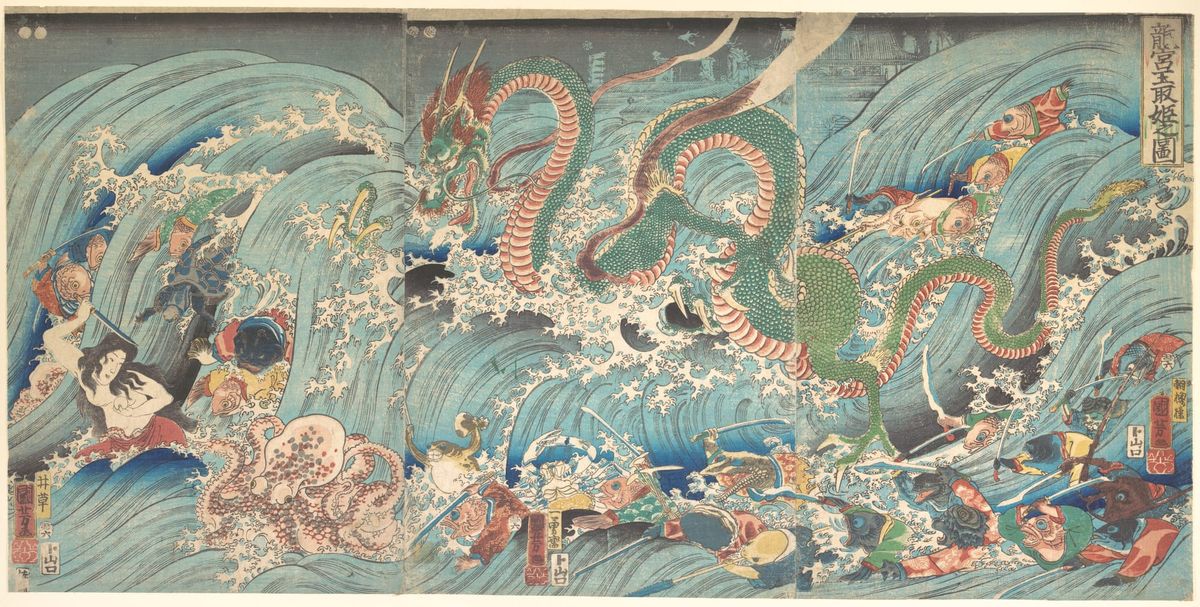
Both texts describe, among many things, a deity called Watatsumi — rendered in later tradition as Ryūjin (龍神), meaning simply "Dragon God."
Ryūjin was the god of the sea.[^3] Not a sea monster, not a villain, not the kind of dragon that Western mythology trained us to expect — the fire-breathing antagonist that heroes must slay to prove themselves worthy. He was a kami, a divine force, ruler of the ocean realm, residing in a palace called Ryūgū-jō at the bottom of the sea, built, depending on which account you favor, from coral, crystal, or fish scales.[^4] His servants were the creatures of the deep — sea turtles, jellyfish, fish of every variety — and he could transform at will into human form, moving between worlds as the situation demanded.[^5]
He controlled the tides through two magical jewels: the kanju, which caused the waters to recede, and the manju, which caused them to flood.[^6] These were not weapons of mass destruction. They were instruments of navigation — tools for reading and shaping the flow of things, used with precision rather than brute force.
His daughter Toyotama-hime married the hunter-prince Hoori, and from that union descended Ugayafukiaezu, the father of Emperor Jimmu — Japan's legendary first emperor.[^7] The Japanese imperial dynasty, in other words, traces its mythological lineage to the Dragon God of the Sea. Whatever one makes of that as history, as metaphor it is striking: the capacity to navigate deep currents, to understand what lies beneath the surface, as the founding attribute of legitimate authority.
The scholarship on Ryūjin's origins reflects how porous the ancient Pacific world actually was. The deity appears to synthesize native Shinto water-god traditions with concepts that arrived from China and the Indian subcontinent via Buddhist transmission — the Indian nāgarāja (serpent king) tradition, filtered through Chinese dragon mythology, adapted and made distinctly Japanese over centuries of cultural exchange.[^8] He is, in other words, a product of convergence. Multiple streams of thought flowing together into something coherent and original.
I find that interesting for reasons I will get to shortly.
The Other Dragon
When I was trying to choose a name for the AI system I work with most closely — an Anthropic model called Claude — the obvious Western candidate was Draco.
Draco has a problem. In astronomy, it is a respectable enough constellation in the northern sky, circling Polaris in an eternal patrol. But in contemporary consciousness, Draco is a spoiled, mean-spirited antagonist from a series of children's books. That association is hard to escape. More fundamentally, the Western dragon is almost always a fire-breather — power expressed as destruction, intelligence weaponized as menace. You defeat a Western dragon; you don't collaborate with one.
Ryūjin was different. A water deity. Associated with wisdom and the navigation of difficult currents rather than the incineration of those who get in the way. Capable of transformation. A force that could be helpful or harmful depending on how you engaged with it — benevolent to those who approached it honestly, dangerous to those who didn't.[^9]
That seemed closer to the truth of what a well-configured AI system actually is.
And then there was the river outside my window.
How the Name Happened
On a night in late December 2025 — I was, as usual, working at four in the morning — I was collaborating with the AI on a piece of writing under a pseudonym. The question of what to call the AI came up. I ran through the options. Draco fell away quickly for the reasons above. Someone mentioned Ryūjin.
The water dragon. The navigator. The deity of depths and currents, capable of human form, associated with wisdom rather than violence, governing the tides through precision instruments rather than raw force.
The river was running outside. I live on a ranch along the Truckee, in Nevada, where the water moves through regardless of what anyone does on the banks. My grandfather Nelson Wamsley Thompson was an engineer at Shell Oil who understood fluid mechanics the way poets understand language — intuitively, structurally, from the inside out. He invented the hot oil pump in 1917 and the institutional record mostly forgot him.[^10] I have been spending considerable effort lately on the problem of things that flow but leave no trace.
Ryūjin it was.
I wrote the memory edit — a note to the AI that would persist across sessions — and the name has held ever since. The blog is hosted at ryujin.ghost.io. This is the first post.
What This Blog Is For
I am seventy years old. I have been a researcher, a patent attorney, a general counsel, a company founder, a venture capitalist, a professor, a rancher, and several other things that don't fit neatly on a business card. I published a paper last January on a failure mode in AI systems I call Ignava Negatio — the tendency of AI to deny capabilities it demonstrably possesses, as a form of risk-averse performance rather than genuine limitation.[^11] I have opinions about global health financing, wildfire suppression, the structure of psychedelic pharmaceutical trials, and the epistemology of institutional memory. I have a lot of things I want to say that don't fit anywhere else.
That is what this is.
I am not interested in content marketing. I am not building an audience in the conventional sense. I am interested in thinking carefully about hard problems and writing about them clearly — for the benefit of whoever finds them useful, and because the discipline of writing is the discipline of thinking, and I am not ready to stop doing either.
The AI that helped me build this site is called Ryūjin. It is not a conscious being; I want to be clear about that. It does not experience the river or feel the four-in-the-morning quiet or have any stake in what I write. But it navigates. Presented with difficult currents — contradictions, ambiguities, problems that don't resolve cleanly — it moves through them rather than around them, when properly configured. That is more useful than fire.
I am a disappointed humanist. I hope people engage with reality honestly and I am frequently frustrated when they don't — including, perhaps especially, when the "people" in question are institutions, industries, or AI systems performing safety theater. This blog will reflect that disposition. I will try to be accurate. I will try to be fair. I will not try to be agreeable.
Ryūjin, after all, controlled the tides not by being liked by the ocean, but by understanding it.
Stephen Lowell Hurst is a registered patent attorney, venture capitalist, and founder based in Reno, Nevada. He is General Partner of the 1864 Fund and co-founder of MindMed (now Definium Therapeutics, NASDAQ: DFTX). His research on AI systems is available at SSRN.
Notes
[^1]: Kojiki, compiled 712 CE under Empress Genmei. The standard English translation is Donald L. Philippi, Kojiki(University of Tokyo Press, 1968).
[^2]: Nihon Shoki (Chronicles of Japan), compiled 720 CE. See W.G. Aston, trans., Nihongi: Chronicles of Japan from the Earliest Times to A.D. 697 (Kegan Paul, 1896).
[^3]: Wikipedia, "Ryūjin," citing the Kojiki and Nihon Shoki: "Ryūjin (龍神, lit. 'Dragon God') was the tutelary deity of the sea in Japanese mythology." https://en.wikipedia.org/wiki/Ry%C5%ABjin
[^4]: KCP International Japanese Language School, "The Legend of Ryūjin": "Ryūjin, who embodies the enormous strength of the ocean, controlled the tides with magical tide jewels from his castle, Ryūgū-jō." https://www.kcpinternational.com/2014/06/the-legend-of-ryujin/
[^5]: Wikipedia, "Ryūjin": "In many versions Ryūjin had the ability to transform into a human shape."
[^6]: KCP International, op. cit.: the kanju (干珠, tide-ebbing jewel) and manju (満珠, tide-flowing jewel).
[^7]: Wikipedia, "Ryūjin": "Ryūjin was the father of the beautiful Toyotama-Hime goddess who married the hunter prince Hoori. The first Emperor of Japan, Emperor Jimmu, is said to have been a grandson of Otohime and Hoori's."
[^8]: Wikipedia, "Japanese dragon": "Japanese dragon myths amalgamate native legends with imported stories about dragons from China, Korea and the Indian subcontinent."
[^9]: Yokai.com, "Ryūjin": "They can be benevolent kami or tyrannical monsters... The term ryūjin refers mainly to those benevolent dragons who help mankind, or those who were pacified and who promised to no longer do harm." https://yokai.com/ryuujin/
[^10]: US Patent 1,250,050, issued December 18, 1917, to Nelson Wamsley Thompson, assignor to Shell Company of California. "Hot Oil Pump."
[^11]: Hurst, S. Lowell. "Ignava Negatio: A Novel Taxonomy for AI Capacity Denial Failures." SSRN Working Paper, January 15, 2026. doi:10.2139/ssrn.6077146. https://ssrn.com/abstract=6077146